The "Won't Deal With" List: Maxwell Frost and Emotional Labor
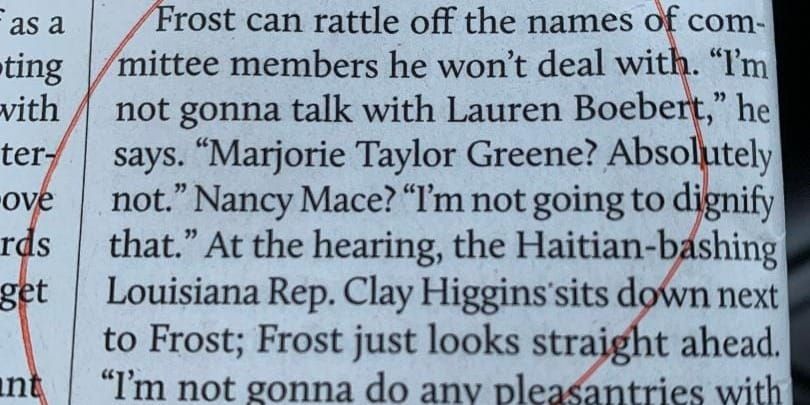
I spent much of my recent vacation reading, working my way through a year-old pile of books and magazines on my dresser: the hopeful “to read” pile that I try to clean out once a year, only to have it immediately replaced with a new stack. During the read-out, I read an article on Representative Maxwell Frost (Florida, District 10). Something he said struck me. I even circled it in red and snapped a picture (above).
Frost can rattle off the names of committee members he won’t deal with. ‘I’m not gonna talk with Lauren Boebert,’ he says. ‘Marjorie Taylor Greene? Absolutely not.’ Nancy Mace? ‘I’m not going to dignify that.’ At the hearing, the Haitian-bashing Louisiana Rep. Clay Higgins sits down next to Frost; Frost just looks straight ahead. ‘I’m not gonna do any pleasantries with that guy,’ he says.[1]
As Frost explains, he has a list of people he won’t deal with, colleagues in Congress that he won’t talk to, neither acknowledge nor make small talk. I think we all have a similar list; I do, but I often succumb to the pressure to be polite. The standard social mantras pop into my head: “It doesn’t hurt you to be polite; you don’t have to like the person, but you have to be polite.” Do I? Which is why Frost’s “won’t deal with list” stands out. He flat out says he won’t acknowledge or talk to certain people. The Frost interview dates from summer 2025. Some six months later, in January of 2026, Frost was the target of a physical assault that included racist insults.[2] The assailant allegedly menaced Frost that “President Trump would deport him.”[3] It’s not a surprise that Frost has a “won’t deal with” list. He is a public figure who has been a visible target of racism and chauvinism. But what about the rest of us? I’d love to stop saying hi to the parent who consistently takes up two parking spots in the small, school pick-up lot. I imagine a long glower at their askew SUV. And when the city councilperson who does not share my values sits next to me at a public forum, can I look away? If politeness dictates that I can’t say what I’m thinking, can I use Frost’s approach: skip the platitudes and refuse to engage?
Researchers have long investigated what is generally termed “emotional labor,” which is defined as the physiological and mental processes tied to managing feelings and expressions to meet the emotional requirements of a job or a social role.[4] Scholars make a distinction between surface and deep acting. According to Singh, Repchuck, and Monaghan, “surface acting involves altering external expressions without changing internal feelings.”[5] I smile and nod to the politician whose values oppose my own. In contrast, deep acting is an alignment of external actions and internal feelings. I sit down, and I don’t acknowledge the politician next to me for the entirety of the event. Deep acting reduces discrepancy between emotions and actions: I don’t like the council member, and I don’t pretend to.
At a recent managerial training, the mot du jour was kindness. One of the PowerPoint slides featured a motivational quotation chosen to echo the workplace’s current anthem: “the culture of care.” The quotation read: “In a world where you can be anything, be kind.”[6] Of course, but I also want to scream, punch something, and watch the system implode. The workplace “culture of care” is the same culture that recently laid off several employees. It has also cut costs and increased workload through attrition. Indeed, it was not lost on the participants of the training that the title of the session was “conflict management.” According to the PowerPoint presentation, in addition to kindness, I am to practice patience, ask open-ended questions, and show compassion when dealing with conflict at work. I’m not opposed to kindness, rather my goal is to be authentic. And I’m not sure how to turn the heavy metal in my head into open-ended questions. I just want to say, politely: “please respond to work emails in a timely fashion; it’s part of your job.”
Researchers have argued that the alignment of emotions and actions creates less emotional stress and thus better mental health.[7] But the broad conclusion is not straight forward.[8] You don’t just get to act how you feel; sometimes, you have to make how you feel match your actions. Singh, Repchuck, and Monaghan’s research shows that deep acting, in many situations, involves an intense effort to align an individual’s internal feelings with external expressions. They cite the example of a mental health worker who, due to the medical situation, must display calm when they feel overwhelmed and anxious. This is difficult. Think of trying to keep it together when you’ve just been rear-ended, or when you get the parent message that the school has gone into lockdown.
In general, when you work to align your emotions and your behavior, you can go two ways. The first way is “negative display rules,” which means you hide your negative feelings, such as “your anger or frustration about something someone has done,” “your disapproval over something someone has done,” or “your fear of someone who appears threatening.”[9] Or, you can take an alternate approach: “positive display rules,” by which you actively adopt positive emotions: “reassure people who are distressed or upset,” “remain calm,” “express feelings of sympathy,” or “express friendly emotions.”[10] It turns out, according to Singh, Repchuck, and Monaghan, that when deep acting is high, when we seriously focus on an alignment of emotions and actions, having to hide our negative feelings (negative display rules) creates more anxiety and anger. And Singh, Repchuck, and Monaghan’s study suggests that positive display rules can have the opposite effect, showing compassion and empathy prove “less taxing or even beneficial.”[11]
Following the research on emotional labor, we, ideally, need to focus on deep acting, aligning our emotions and our external behavior. We can take the Frost method: skip the pretense and don’t engage with the colleague we know we can’t work with. But we can also move in the other direction, changing our emotions to meet the behavior. It’s hard, and—as the research suggests—unhealthy to suppress negative emotions, but we can learn to develop a positive emotional response: empathy, compassion, reassurance. This isn’t kindness per se; it’s more of a purposeful cultivation of positive emotions for an ultimately selfish purpose: it’s better for us. I’m tempted, daily, to growl at the bad-parker parent, and I’d love to ignore the colleague until they respond to my email, but—simply put—reframing my disapproval and anger into compassion and empathy is much better for my mental and physical health. Maybe what I need is Frost + positive display rules. I don’t engage with the bad parker or the email denier, and instead of internally raging, I quietly work on building my positive response skills. It’s true, the school pick-up lot is quite narrow, and emails sometimes get lost.
Maxwell Frost cited in “Why Maxwell Frost Wants Democrats to ‘Get Caught Fighting’” by Tim Murphy, Mother Jones (May/June 2025). https://www.motherjones.com/politics/2025/05/maxwell-frost-democratic-opposition-doge-elon-musk-donald-trump/ ↩︎
"Man charged with assaulting Rep. Maxwell Frost at Sundance Film Festival" by Lindsey Bahr, Associated Press, PBS News (26 January 2026). Accessed online. ↩︎
"Democratic congressman punched in racist attack at Sundance film festival" by Lauren Gambino, The Guardian (25 January 2026). Accessed online. ↩︎
The term, “emotional labor,” comes from the sociologist, Arlie Hochschild, whose The Managed Heart: Commercialization of Human Feeling (University of California Press, 1983) studied flight attendants, investigating how and to what cost the attendants manage emotions as part of their daily work. ↩︎
“The Complexity of Deep Acting: A Study of Emotional Labor in Frontline Human Service Work” by Diana Singh, Ruth Repchuck, and Jessica Monaghan in Society and Mental Health (30 June 2025). Accessed online. ↩︎
The citation was attributed to Clare Pooley. ↩︎
Singh, Repchuck, and Monaghan. ↩︎
Researchers found, for example, that surface and deep acting consume the same amount of prefrontal cortex energy, suggesting that the two processes are similar in terms of brain functions. See Lu, Wu, Mei, Zhao, Zhou, Li and Pan, “Surface Acting or Deep Acting, Who Need More Effortful? A Study of Emotional Labor Using Functional Near-Infrared Spectroscopy,” in Frontiers in Human Neuroscience (10 May 2019). https://www.frontiersin.org/journals/human-neuroscience/articles/10.3389/fnhum.2019.00151/full ↩︎
Singh, Repchuck, and Monaghan. ↩︎
Singh, Repchuck, and Monaghan. ↩︎
Singh, Repchuck, and Monaghan. See also Ma, Zhang, Dong, and Yu’s study of the emotional labor of teachers in the classroom, where they conclude that “when teachers’ feelings and required emotions are inconsistent, emotions of love, caring, enjoyment motivate teachers to perceive display rules as a means to change their cognition.” Ma, Zhang, Dong, and Yu, “The Relationship between Teachers’ Emotional Labor and Display Rules, Trait Emotions, Exhaustion, and Classroom Emotional Climate,” Frontiers in Psychology (26 February 2023). https://www.frontiersin.org/journals/psychology/articles/10.3389/fpsyg.2023.957856/full ↩︎