How Much Does it Cost to Vote? Campaign Finance in Vigo County, Indiana
In Vigo County, local campaign finance reports show that incumbents have a financial advantage; corporate and PAC donors give the most money, and they give across party lines; and a large percentage of the campaign donations to local candidates comes from outside Vigo County.
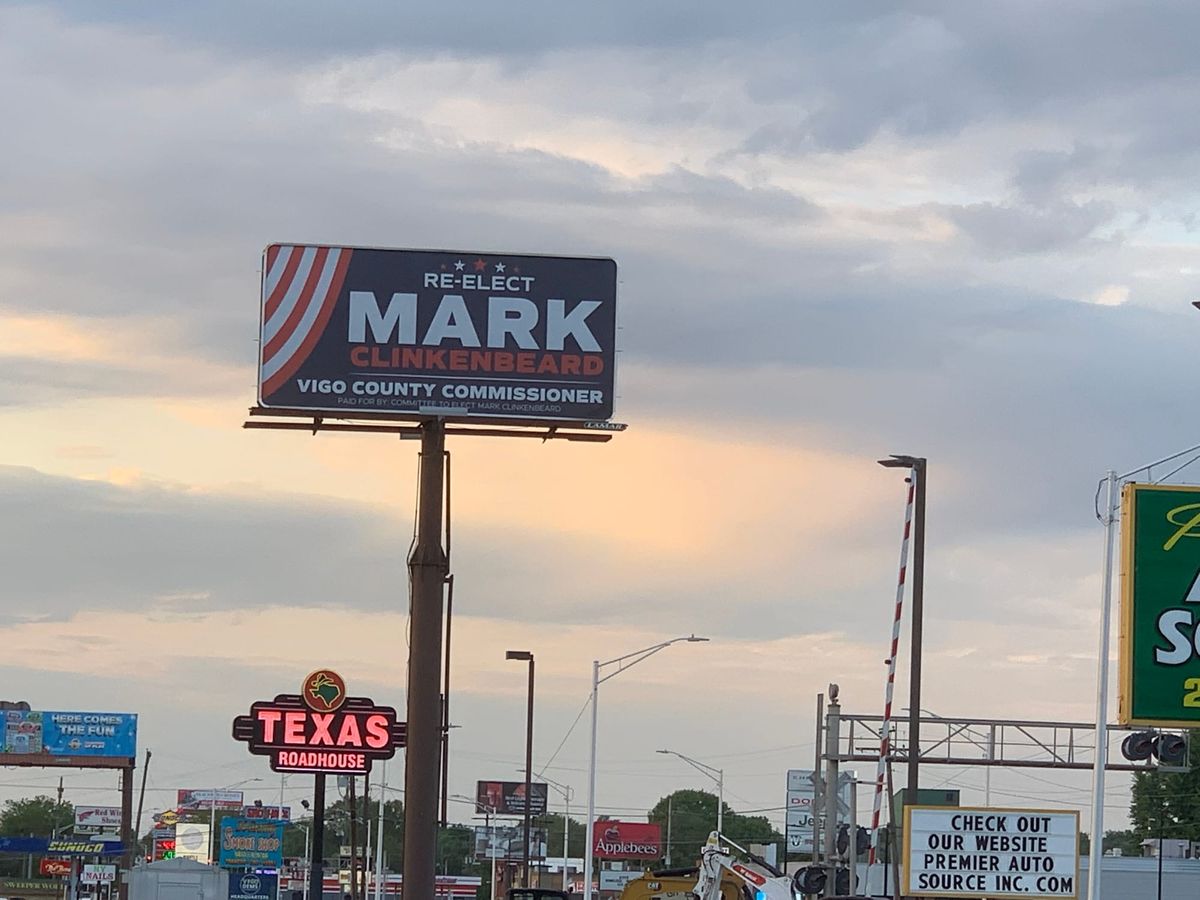
On the morning of the May 2026 primaries, as I was rushing to drop kids, get myself to the polls, and then to work, my son asked: “How much does it cost to vote?” At first, I was taken aback. “It’s free,” I said. And then I forgot about his question, busy with the day. Later that night, as I refreshed the election results, his question came back to me: “How much does it cost to vote?”
Technically, voting is free. But, of course, there is a long list of indirect costs: citizenship, state-approved identification, transportation, time, and information. And as I watched the election results update over the course of a few hours, I kept thinking about the other, major cost: campaign finance. In Vigo County, local campaign finance reports show that incumbents have a financial advantage; corporate and PAC donors give the most money, and they give across party lines; and a large percentage of the campaign donations to local candidates comes from outside Vigo County. Scholarship on campaign finance in the United States tells us that these are common elements of U.S. elections. Vigo County is not unique; it is simply a case in point and an example of how things work at the local level. Elections have costs, and while the average citizen is not excluded, they are largely absent from the market of campaign finance.
An Explanation of Sources and Methodology
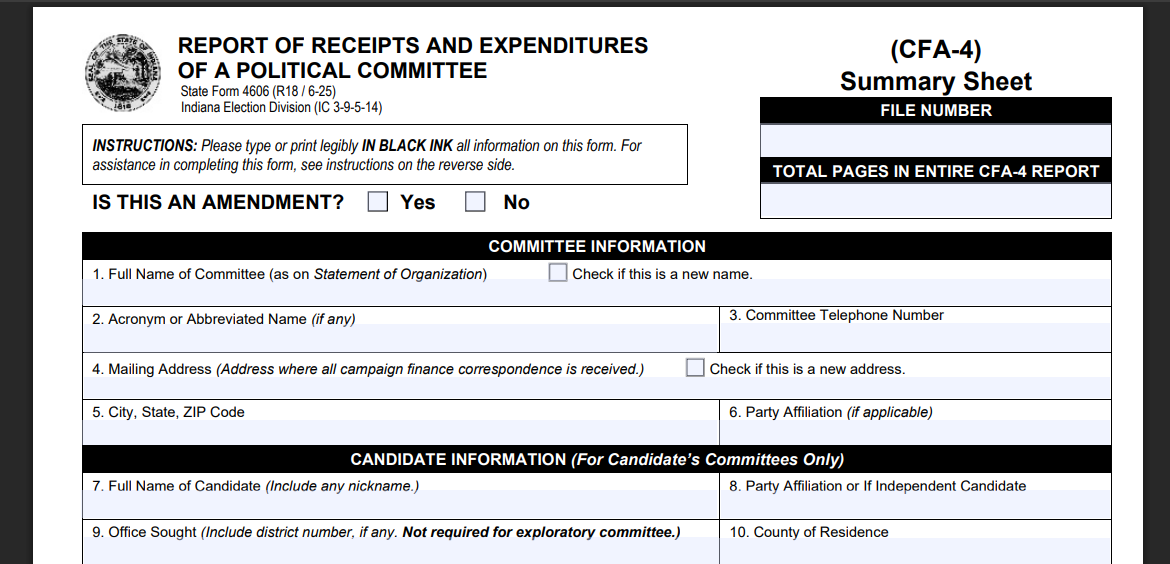
The information in this piece is from two sets of campaign finance reports. The first is the Annual Indiana CFA-4 report (Report of Receipts and Expenditures of a Political Committee), which is the official state document used by candidate, political action, and party committees to disclose campaign finance activity. The form requires the reporting of all contributions, expenditures, debts, and loans. The 2025 annual report discloses campaign finance activity from January 1 to December 31, 2025. Eighty-nine local candidates filed a 2025 Annual CFA-4 report in Vigo County. Many are former candidates or office holders, others are currently elected officials, and the third group is those running for election in 2026. All of the 89 Annual CFA-4 reports are publicly available online at the Vigo County Election Board website.[1] The second set of reports, also CFA-4, are the 2026 Pre-Primary Reports. Indiana requires candidates on the primary ballot to file a CFA-4 report 25 days before the primary election.[2] The Pre-Primary Reports are filed ahead of the primary to give the public time to review the information before election day.[3]
I spent the past several months reviewing the annual CFA-4 reports, sorting and coding for specific data points. I was curious, for example, how much money comes from outside Vigo County, from Indianapolis, and from outside the state. I also wondered how much money is coming from specific interest groups and PACs (developers, unions, consulting firms, builders, realtors). The analysis, at first glance, might appear biased in that the data comes from a handful of candidate filings. However, this research does not target particular individuals or entities. Rather the campaign finance data is limited to those candidates who had substantial reports, meaning they reported numerous campaign finance activities in 2025. This is because 38 out of the 89 candidates had nothing to report. Many of them are currently elected officials who are not up for re-election or they are no longer seeking public office. Another 23 candidates simply reported cash on hand for the same reasons: they are not actively raising or spending campaign monies. This leaves only 28 annual CFA-4 reports with cited activity. And among these 28 reports, those with the most campaign finance activity are from high-profile candidates who are preparing or running in key local races: mayor, sheriff, county commissioner, and county prosecutor.[4] The Pre-Primary 2026 reports follow the same pattern: big candidates in big races show the most campaign finance activity.
The Money: Who Gives to Whom?
Let’s start at the top. At the beginning of the reporting period (January 1, 2025), Terre Haute Mayor Brandon Sakbun had over $200,000 cash on hand. During 2025, he raised another $250,000. When you subtract his 2025 expenditures, he ended the year with a total of $406,000 in campaign finance.[5] Sakbun is currently in his third year as mayor. His first term will end on December 31, 2027.
Campaign finance is reported on the CFA-4 form in three main categories: individual donors, corporate donors, and donations from PACs.[6] The summary breakdown of Sakbun’s 2025 campaign donations stands at $53,500 from individuals, $18,000 from corporations, and $136,700 from PACs, which total $208,000 raised.[7] The $53,500 in individual donations raised represent just over a quarter (or 26%) of all donations raised. Individuals ranging from local, city residents to national leaders gave to Sakbun’s campaign. Destiny Wells (Indianapolis), for example, donated $1,000 to his campaign, while Andrew Yang (New York) gave $1,029.[8] Individual donors from Florida, Illinois, Ohio, and Tennessee also gave to Sakbun.[9] Out-of-state individual donors made up roughly 7% of the total donations raised from individuals. Donors from the Indianapolis metropolitan area, including Carmel, Fishers, Noblesville, and Zionsville, make up half (50%) of individual donations to Sakbun, while donations from the rest of the state (Bloomington, Brazil, Evansville, Fort Wayne, Lebanon, Mount Vernon, Sullivan,) total 14%. Finally, individual donors from Terre Haute make up almost three out of every ten donors (or 29%) of the $53,500 raised in 2025. While 93% of individual donations to Sakbun come from Indiana, most of the in-state donations are not local.
A different pattern emerges for donations from corporations. Corporate donations are the smallest part of Sakbun’s campaign contributions, representing only one-eleventh (or 8.7%) of the total donations received in 2025. Within this category, local businesses are the largest group of donors, totaling over two-fifths (or 43%) of corporate donations. Most of the local corporations are developers, builders, and related services, including Advantage Plus Two (real estate), Hannig Construction, Keymark Development, and Phillips & Associates (property management). Donations from Indianapolis make up just over a quarter (or 26%) of Sakbun’s corporate donations, with the majority being from developers and engineering firms (Donohue & Associates, EnviroForensics, Janssen & Spaans Engineering, RQAW). Businesses from the areas surrounding Vigo County: Brownsburg, Lawrence, and New Palestine, as well as across the border in Illinois: Marshall, Streator, and Urbana, make up another quarter (26%) of corporate donations.[10]
Finally, the largest portion of Sakbun’s campaign finance in 2025 comes from $136,700 in donations from political action committees, which make up almost two-thirds (or 66%) of the total money raised in 2025. Out of those PAC donations, nearly three-quarters come from Indianapolis. This is understandable as many political action committees are headquartered in the state capital. As with corporate donations, major contributors are mostly builders, developers, real estate, infrastructure, and energy companies, including donations from Central Indiana Constructors PAC, CHA Consulting PAC, Commonwealth Engineers PAC, Heritage Builds PAC, Indiana American Water PAC, and the Indiana Realtors PAC, all located in Indianapolis. In Vigo County, Sakbun raised $28,000 primarily from local union PACs (carpenters, firefighters, electricians, plumbers, steamfitters).
Research on campaign finance has long established that the choice of who to fund is a calculated move. Political scientists Barber, Canes-Wrone, and Thrower show that donors are not “uninformed boosters who simply fund a local or in-party candidate who happens to reach out, but are instead sophisticated consumers.”[11] Numerous journalists and scholars have documented the power of local campaign donations. Ava Rodriguez writes that “Donations do not always buy direct outcomes, but they often buy attention. A candidate is more likely to recognize and remember the people who helped keep the campaign running. On the local level, that familiarity can later translate into easier access, faster responses, more invitations into policy conversations, and a stronger chance that a donor’s concerns will be treated as politically important.”[12]
Mayor Sakbun ran on and has maintained a pro-business and development-centered administration with a specific focus on housing.[13] That builders and developers are among his top donors is therefore not surprising.[14] Recent research shows that there is an association between what politicians talk about and who finances their campaigns. As Goel et al. state, “there is a clear positive relationship between who gives money to politicians and what those elected officials talk about.”[15] Sakbun’s 2025 campaign finance report follows his platform and his first years in office as construction, development, and infrastructure firms are dominant. Corporate and PAC donations combined comprise three-quarters (74% ) of the $208,000 raised.
Campaign finance for the county commissioners follows a similar pattern: a majority of corporate and PAC finance, including money from Indianapolis, all dominated by donations from builders, developers, and consulting firms. The county commissioners’ 2025 campaign funding is unique in that the bulk stems from the Commissioners’ Annual Golf Outing (June 23, 2025). The money raised from the golf outing is split three ways, a third going to each sitting commissioner’s campaign: Mark Clinkenbeard, Mike Morris, and Chris Switzer. The golf outing raised a total of $72,000: $3,000 from individuals (or 4% of the total), $51,800 from corporations (or 72%), and $17,150 from PACs (or 24%).[16] Individual donations (a total of only four) include two donations from Terre Haute (total of $1,050), one from out of state ($1,000), and one from Indianapolis ($1,000). Thus, two-thirds of the dollar amount of individual donations were from outside Vigo County, which is similar to the mayor’s individual donations.
Corporate donations to the county commissioners also mirror the mayor’s in that almost two-thirds (64%) of corporate donations raised for the commissioners came from local donors. Corporate donations from neighboring cities and counties accounted for a little more than a quarter (28%) of the county commissioner’s corporate donations, while only 4% of their corporate donations came from Indianapolis. Critically, the same local businesses gave to both the mayor and the county commissions in 2025: Culligan Water, Hannig Construction, and Vomac Truck Sales. The same is true for corporate donations outside of Terre Haute. Evergreen Roadworks (Champaign, IL) gave to both the mayor’s and the county commissioners’ campaigns, as did Fishbeck (engineering, architect, and design firm from Grand Rapids, MI). Only two local PACs gave to the commissioners, leaving 82% of the commissioners’ PAC funding coming from Indianapolis. Parallel to the mayor’s campaign, the same PACs gave money to the commissioners: Central Indiana Constructors PAC, Heritage Builds PAC, Indiana American Water PAC, and Ironworkers Local 22 PAC.
The comparison between the mayor’s and the commissioners’ campaign finance is a local case in point of what scholarship has long shown: corporate donors and PACs regularly give across party lines. In this case, that means campaign donations to a Democratic mayor and three Republican county commissioners. Scholars have shown that corporate donors and PACs ultimately “invest” in candidates “who will represent their professional interests.”[17] Party lines are secondary to the first priority of profit generation.[18] Both the city and the county have adopted Sakbun’s “pro-growth mindset,” with a focus on infrastructure, new housing, and commercial development.[19] As Sakbun stated: “we [the Democratic party] need to be the party of builders.”[20] The 2025 CFA-4 reports suggest that the mayor and the county commissioners are indeed “the party of builders” with their campaigns largely financed by builders, realtors, developers, engineering and architecture firms, utilities, and labor unions tied to the building trades.
The Candidate Loop
Another interesting aspect of local campaign finance is that candidates regularly give to other candidates’ campaigns. This is most evident in the 2026 Pre-Primary CFA-4 reports, which show giving across campaigns. Mark Clinkenbeard’s Campaign for Commissioner gave to Terry Modesitt’s campaign for county prosecutor and the Committee to Elect David Thompson (current incumbent, County Councilmember, District 1, Republican). And both the Committee to Elect Chris Switzer and the Committee to Elect Mike Morris gave to Clinkenbeard’s campaign.
Candidate-to-candidate finance also occurs directly with candidates giving in their own name to other candidates. Mark Clinkenbeard, for example, gave to the Committee to Elect Brad Newman, and Brandon Sakbun gave to the Committee to Elect Fell for Sheriff. Similarly, Morris Trucking Corporation, owned by County Commissioner Mike Morris, gave to Modesitt’s campaign. Local campaign finance reports show candidates giving to other candidates, strategically building alliances across the local political network through campaign donations.
Money Wins (Mostly)
Scholarship on campaign finance has tracked a bias toward incumbents, namely they raise more money, which can translate into an advantage at the polls.[21] Several local examples follow national trends. In the 2026 primary for sheriff, for example, the Democratic incumbent, Derek Fell, won the Democratic primary with 48.98% of the votes. David Ewing came in second with 28.06% and Larry Cheeks third with 22.95%.[22] The Committee to elect Fell for Sheriff reported $41,000 cash on hand as of January 1, 2026, compared to Ewing ($24,000) and Cheeks, who had no cash on hand as of January 1.[23] Fell raised an additional $15,000 from January 1 to April 10, 2026, while Ewing raised $8,000 and Cheeks $4,600. Fell’s Pre-Primary report lists donations from 44 individuals, 4 local businesses, and two labor unions, while both Ewing’s and Cheeks’ campaigns were primarily self-funded.[24]
Mark Clinkenbeard won the Republican primary for County Commissioner, District 1 (74.97% of the votes) with $51,000 cash on hand, $6,500 raised from January 1 to April 10, and $20,000 in expenditures. His opponent Jodie Akinbo had no cash on hand, raised $1,500, and spent $1,500 on her campaign. In the primary for County Council, District 1, incumbent David Thompson (Republican) reported $42,000 cash on hand as of January 1, 2026, and he raised an additional $11,000 between January 1 and April 17, the bulk from individual donors. His opponent, Johnny Norton reported no cash on hand, no contributions, and no expenditures. Thompson won the primary with 70.55% of the vote.
There are exceptions, however. In the Democratic primary for County Council, District 1, for example, Kim Curley reported no cash on hand, no contributions, and no expenditures. Her opponent, Devan Allen reported no cash on hand, but he raised $3,900, and reportedly spent $3,645 on the primary race. Curley won the primary with two-thirds of the votes. Similarly, in the Republican primary for County Council, District 4, Dusty Havens won with 44.22% of the vote and about $1,500 in campaign finance, compared to his opponents who had more than double and triple the amount.[25] With the next CFA-4 reports due in October 2026, in advance of the November election, it will be interesting to follow up on these specific races.
Conclusion: Voters Sidelined
It was refreshing to discover that a number of Vigo County candidates in the 2026 primaries ran with little to no campaign finance and/or their campaigns were self-funded. These candidates put themselves out there, on their own terms, and with their own resources.
Nevertheless, campaign funding reigns supreme. In his recent appearance on the radio segment “Ask the Mayor” on WFIU, Mayor Sakbun criticized out-of-state campaign finance, describing it as “dark money, D.C.-super PAC groups that want to get involved in the great state of Indiana.”[26] Sakbun continued: “folks, elections are not bought and paid for.”[27] The review of Vigo County CFA-4 forms suggests otherwise; substantial payments are being made in local elections. What they buy or don’t buy is beyond the scope of this article. However, scholarship on state and national elections suggests that rational and self-interested individuals, corporations, and interest groups invest their funds in candidates because they expect a return.[28] Sakbun’s criticism of out-of-state campaign funding is surprising given his own and other campaigns’ use of money from Indianapolis and beyond.
There is no big reveal from Vigo County campaign finance reports. Rather the review shows that local campaign finance is broadly consistent with what happens elsewhere in the U.S. “How much does it cost to vote?” Voting is free, but those who pay are heard more clearly.
The reports are listed on the Vigo County Election Board website.as “2026 Annual reports.” While the reports were filed in 2026, they report campaign finance for the calendar year of 2025. All of the reports are posted by the candidate’s first and last name. The reports are also ordered alphabetically, Z to A, and include both the date they were posted and the number of times the individual reports have been viewed. The number of times the reports have been viewed suggests areas of interest. Consider, for example, the 2025 Annual CFA-4 report for Brenda Wilson (which records campaign finance for her Committee to Elect Brenda Wilson for Vigo County Council Member at Large). As of May 16, 2026, her report had been viewed 434 times, which is the highest viewing of any Vigo County 2025 CFA-4 report. For comparison, Terre Haute Mayor Brandon Sakbun’s 2025 CFA-4 report had been viewed 276 times, also as of May 16, 2026. While Traci McNeil’s report (current Linton Township Trustee,) had been viewed 115 times. ↩︎
See Indiana State Code, 3-9-4-5; and Indiana State Code, 3-9-5-9 ↩︎
As of May 29, 2026, the Pre-Primary Reports are not yet publicly available on the Vigo County Election Board website, but citizens can submit an information request to the Vigo County Election Board to receive copies of the 2026 Pre-Primary reports. ↩︎
This article focuses on the campaign finances for local races and thus purposely excludes consideration of state races, such as the contested 2026 Republican primary for State Representative, District 38. General media outlets have long covered the influx of money in state races, including the 2026 Republican primary. See Tom Davies’ piece on Indiana State Senate District 38 from the Indiana Capital Chronicle. Niki Kelly, also in the Indiana Capital Chronicle, explains her recent attempts to track campaign finance in the case of Governor Mike Braun. ↩︎
Numbers have been rounded. Exact amounts are publicly available on Sakbun’s 2025 Annual CFA-4 report via the Vigo County Election Board website. ↩︎
The contributions are “itemized,” which means the donor’s name, address, type of contribution, and amount are listed. Candidates can also list “unitemized” contributions, which are reported as a lump sum on the summary page of the report. In addition to individual, corporate, and PAC donors, the form also includes an “other” category. The review of campaign finance reports in this article draws solely from itemized individual, corporate, and PAC donations. ↩︎
Sakbun reported additional donations from “other organizations,” and his report includes over $9,000 in “unitemized” donations. I have rounded exact numbers and percentages to give a general overview. ↩︎
Destiny Wells, Democrat, unsuccessfully ran for Indiana secretary of state in 2022, state attorney general in 2024, and Congress in 2026. Andrew Yang was a candidate for the Democratic presidential primary in 2020. ↩︎
Many of these donations stem from state and national Democratic party fundraising. ↩︎
The remaining 5% of corporate donations to Sakbun’s campaign come from areas outside of Indianapolis, Vigo County, and their environs. ↩︎
Michael J. Barber, Brandeis Canes-Wrone, and Sharece Thrower, “Ideologically Sophisticated Donors: Which Candidates Do Individual Contributors Finance?” American Journal of Political Science 61.2 (April 2017), p. 285. Accessed online. ↩︎
Ava Rodriguez, “How Local Businesses Influence Politics Through Donations,” PulseGulfCoast (20 April 2026). Accessed online. ↩︎
See the Mayor’s newsletter where he regularly touts city development projects, from parks to demolition to housing. You can also browse the Mayor’s social media page for further examples. In addition, you can listen to Sakbun’s most recent appearance on “Ask the Mayor” on WFIU, in which he repeats what has become his stump speech on the need for development, including more affordable housing. See Joe Hren, “Ask the Mayor: Terre Haute’s Sakbun on primary results, road funding, keeping grads,” WFIU (13 May 2026). Accessed online. ↩︎
Barber, Canes-Wrone, and Thrower, p. 283. ↩︎
Goel, Malkin, Gaynor, Jojic, Miler, Resnik, “Donor Activity is Associated with US Legislators’ Attention to Political Issues,” PloS ONE 18(9): 2023, p. 14. Accessed online. ↩︎
These calculations do not take into account any expenditures for the golf outing. The focus is on how much money is coming in and from where. Numbers come from Chris Switzer’s individual 2025 CFA-4 report. ↩︎
Barber, Canes-Wrone, and Thrower, p. 283. ↩︎
Barber, Canes-Wrone, and Thrower, p. 273. See also Goel, Malkin, Gaynor, Jojic, Miler, and Resnik. ↩︎
Joe Hren, “Ask the Mayor,” WFIU (13 May 2026). See also the County Commissioners’ social media page, as well as the social media pages for each individual commissioner: Mark Clinkenbeard, Mike Morris, Chris Switzer. ↩︎
Joe Hren, “Ask the Mayor,” WFIU (13 May 2026). ↩︎
The advantages of incumbents have long been studied at the national level. Alexander Fouirnaies and Andrew B. Hall, for example, find that “strategic interest groups direct money to incumbents in exchange for access . . . and access-oriented interest group donors account for approximately two-thirds of the overall causal financial incumbency advantage.” See Fouirnaies and Hall, “The Financial Incumbency Advantage: Causes and Consequences,” The Journal of Politics 76.3 (1 July 2014), p. 2. Accessed online. ↩︎
Elections results from: Vigo County Elections Board ↩︎
Again, amounts are rounded for ease of reporting. ↩︎
A comparison with the 2026 Republican primary for Vigo County sheriff is not possible, as Steve Ellis’ Ellis for Office Committee reported no cash on hand, no contributions, and no expenditures. ↩︎
The Committee to elect Jim Donohue raised over $9,000, and the Committee to Elect Justin Kunz raised over $5,000. ↩︎
Joe Hren, “Ask the Mayor,” WFIU (13 May 2026). ↩︎
Joe Hren, “Ask the Mayor,” WFIU (13 May 2026). ↩︎
See Barber, Canes-Wrone and Thrower; Fouirnaies and Hall; and Goel, Malkin, Gaynor, Jojic, Miler, and Resnik. ↩︎